Money advice has never been louder. Short-form videos promise a portfolio by Friday, apps send push notifications about assets you had not heard of last month, and AI chatbots will happily generate a financial plan on request. What almost none of it tells you is the unglamorous part: the order in which money decisions should happen — because the order is boring, and boring does not get clicks.
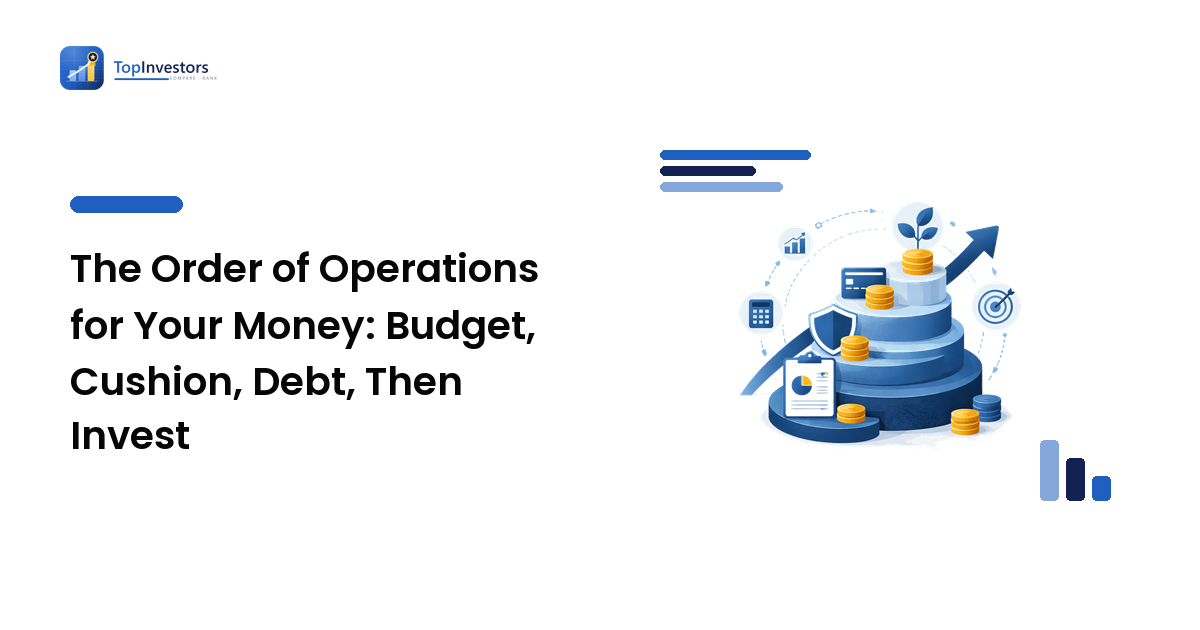
It does, however, work. Personal finance has an order of operations, the same way arithmetic does: know your numbers, build a cushion, clear expensive debt, and only then invest. Do the steps out of sequence and each one undermines the next — invest before the cushion exists and the first emergency sells your investments at the worst moment; budget after the debt spirals and you are budgeting around interest instead of goals.
This guide is the map of that sequence — what each step is for, what it asks of you, and where the order can sensibly bend. It is general education, not personalized financial advice: your situation, and in places your country's rules, will shape the details.
Step 1: Know your numbers before you change them
Every budgeting method, app, and philosophy is a wrapper around one act: seeing what comes in and what goes out, in categories honest enough to act on. Until that picture exists, every other money decision is a guess.
The common systems differ mainly in how much structure they impose, and each has a real trade-off:
- The 50/30/20 rule — a widely discussed rule of thumb that sorts take-home pay into needs, wants, and saving-plus-debt-payments. Its strength is that it takes minutes to apply; its weakness is that the ratios are a starting point, not a law, and high-rent cities or low incomes can make the tidy split unrealistic.
- Zero-based budgeting gives every unit of income a named job before the month begins. Maximum awareness, maximum effort — powerful when money is tight, heavier than many people will sustain when it is not.
- Pay-yourself-first automates saving on payday and lets you spend the rest guilt-free. The lightest touch and the easiest to maintain — at the cost of visibility into where the spending actually goes.
The honest selection criterion is not which system is best but which one you will still be running in six months. A rough budget you repeat beats a perfect one you abandon — consistency is what the later steps are built on.
Step 2: Build the cushion that protects everything else
An emergency fund — money set aside for genuine surprises like a job loss, a medical bill, or a major repair — is the least exciting account you will ever hold and the one that makes every other step durable. Without it, any shock lands on a credit card or forces you to sell investments on someone else's schedule; with it, an emergency is an inconvenience instead of a setback.
Two properties matter more than the exact size: it must be liquid (reachable in days, not locked away) and separate (not mingled with spending money, where it quietly erodes). Commonly discussed targets run from a small starter cushion up to several months of essential expenses, and the right point in that range depends on how steady your income is — a salaried employee and a freelancer need different depths of buffer.
How much to aim for first, where to keep it, and how to fund it without derailing everything else is a step-by-step topic of its own: how to build an emergency fund walks through it from zero.
Step 3: Take expensive debt off the table
Debt is not one thing. A mortgage, a student loan, and a credit card balance are all borrowing, but they differ in the number that decides everything: the interest rate. Compounding — the process that quietly grows investments — works exactly as hard against you on debt, and high-rate debt compounds against you faster than most investments can be reasonably expected to compound for you. That is why clearing expensive debt ranks ahead of investing in the sequence: paying off a high-rate balance is, in effect, a guaranteed return at that rate, and guarantees are rare in finance.
For the paydown itself, two named strategies dominate the discussion, and the trade-off between them is psychological as much as mathematical. The avalanche method pays the highest rate first, which minimizes total interest. The snowball method pays the smallest balance first, which produces early wins that keep people going. The mathematically optimal plan is worth nothing if it gets abandoned in month three — choose the one that fits your temperament.
Lower-rate debt is a genuinely closer call, and the full decision framework — when clearing debt should outrank investing and when it should not — is laid out in should you pay off debt or invest first. And since the cheapest debt is the kind you price properly before taking it, how to compare loan apps before you borrow covers reading the real cost behind a headline rate.
Step 4: Now the foundation can hold an investment
With a working budget, a funded cushion, and expensive debt cleared or shrinking, investing stops being a gamble stacked on a shaky base and becomes what it should be: surplus money given time to compound. The foundation is precisely what lets you leave investments alone through market swings — which, historically, is the behavior long-term investing has rewarded.
What stocks, bonds, and funds actually are, how compounding and diversification work, and the mental framework to build before committing anything is the territory of our investing basics guide — the natural next read once the first three steps are moving.
Where the order bends
A strict sequence is a teaching device; real life runs steps in parallel, and two bends are widely considered sensible:
- Employer retirement matching, where it exists. Some employers match a portion of retirement contributions — commonly described as the closest thing to free money in personal finance. Capturing a match can be worth prioritizing even while debt remains, because the immediate effective return is hard to beat. Whether that applies to you depends on your employer and country.
- Momentum beats purity. Putting something toward the cushion while chipping at debt, rather than finishing one perfectly before starting the other, keeps both habits alive. Progress on two fronts at once is slower per front and more likely to survive contact with a real month.
What the order should not bend for is noise: a trending asset, a friend's windfall story, or the fear of missing out. The sequence exists precisely so that those moments have a pre-made answer — "not until the step it belongs to."
FAQ
What is the order of operations in personal finance? A commonly taught sequence: track income and spending with a budget you can sustain, build a liquid emergency cushion, pay down high-interest debt, then invest the surplus for the long term. Each step exists to make the next one safe.
Should I start investing before I have an emergency fund? The widely discussed caution is that without a cushion, an emergency forces you to sell investments on the market's timing rather than yours — possibly at a loss and, in some places, with tax consequences. That risk is why the cushion generally ranks first.
Which budgeting method is best? The one you will still be using in six months. Zero-based budgeting maximizes control at high effort; 50/30/20 is fast but approximate; pay-yourself-first is nearly effortless but low-visibility. Matching the method to your temperament matters more than the method itself.
Do I need to be debt-free before investing? Not necessarily. The distinction that matters is the interest rate: clearing high-rate debt first is close to a guaranteed return, while low-rate debt can reasonably coexist with investing. It is a trade-off you can evaluate, not a purity test.
How much of my income should I save? There is no universal number, and be wary of anyone offering one. Rules of thumb like the 20 in 50/30/20 are starting points; what compounds over the years is the habit of saving consistently — automated, and increased when income rises.
None of this is personalized advice — it is the durable shape of the decisions, laid out so the loud stuff has somewhere to bounce off. Start with the step you are on, not the one that is trending. For more plain-language guides to money and markets, visit TopInvestors.