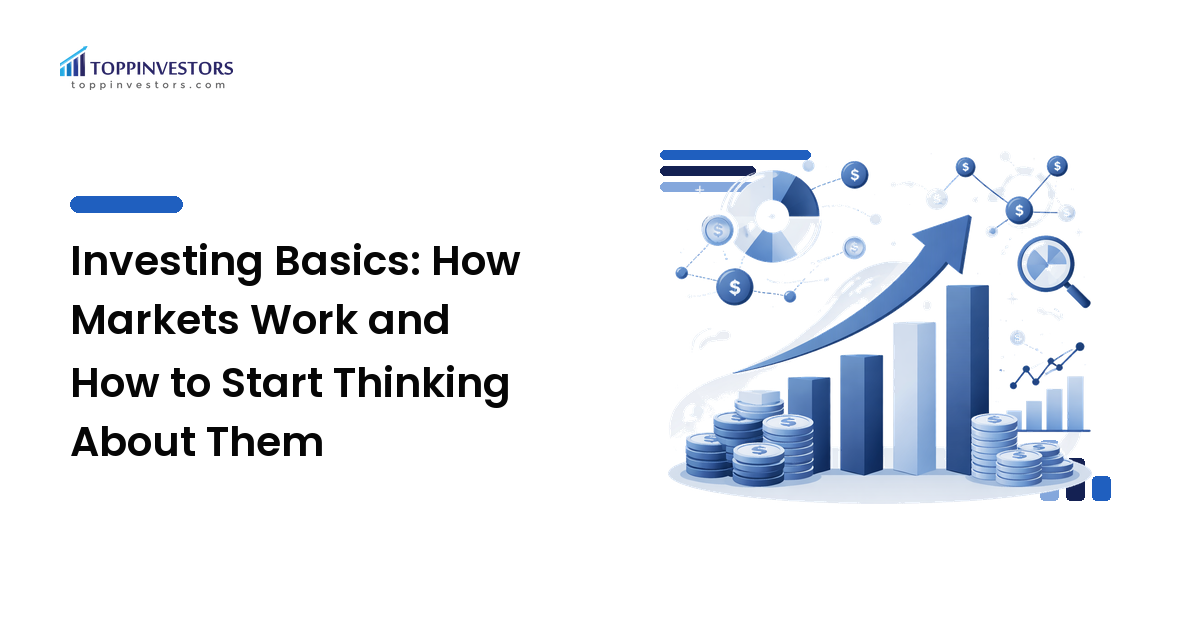
Investing can feel like a private club with its own vocabulary, where everyone else seems to know the password. The good news is that the core ideas are simpler than the jargon suggests. This guide explains, in plain language, what you are actually buying when you invest, how money can grow over time, and how to build a clear mental framework before you commit a single dollar.
The short version: an investment is a claim on future value, returns and risk travel together, time and compounding do most of the heavy lifting, and spreading your money around reduces the damage when any one thing goes wrong. Understand those four ideas and most financial headlines become a lot less intimidating.
Not financial advice. This article is general educational content. It is not personalized investment, tax, or financial advice, and the numbers used are illustrative examples. Your situation is unique — consider speaking with a licensed professional before making decisions.
What "investing" actually means
Saving is setting money aside. Investing is putting money to work so it has a chance to grow. When you invest, you exchange cash today for an asset you expect to be worth more — or to pay you income — later. That expectation is never a guarantee, which is the whole reason returns exist: you are being compensated for accepting uncertainty.
Every investment sits somewhere on a spectrum between safety and growth potential. A savings account is very safe but grows slowly. A share in a single company might grow quickly or lose value entirely. Most sensible approaches live somewhere in between, and the rest of this guide is about understanding that middle ground.
The main building blocks
You do not need to know hundreds of products. A few core ones explain most of the market.
Stocks
A stock (or "share") is a small piece of ownership in a company. If the company grows and becomes more valuable, your share can rise in price; some companies also pay out a slice of profits as dividends. Stocks have historically offered higher long-term growth potential than most other mainstream assets — and also larger swings in value along the way. Owning a stock means accepting that its price can fall sharply and stay down for a while.
Bonds
A bond is essentially a loan you make to a government or company. In return, the borrower typically pays you regular interest and promises to return the original amount on a set date. Bonds are generally steadier than stocks and produce more predictable income, which is why they are often used to balance out a portfolio. They are not risk-free — borrowers can default, and bond prices move when interest rates change — but they usually behave more calmly than stocks.
Funds
A fund pools money from many investors to buy a basket of assets at once. Instead of choosing individual stocks, you buy one fund and instantly own a slice of everything inside it. Two common types are index funds, which simply track a broad market index, and ETFs (exchange-traded funds), which trade like stocks throughout the day. Funds are popular precisely because they make diversification easy and cheap for an ordinary investor.
How money grows: compounding
Compounding is the quiet engine behind most long-term investing. It means earning returns not just on your original money, but also on the returns it has already generated. Over short periods the effect is barely noticeable. Over decades it can dominate everything else.
Consider a simple illustration: suppose an investment grows at an average of 7% a year (a hypothetical figure, not a promise). A sum left untouched would roughly double about every ten years at that rate. The investor who starts earlier and leaves the money alone often ends up far ahead of someone who invests more but starts later — not because they were smarter, but because they gave compounding more time to work.
The practical takeaways are unglamorous but powerful: start when you reasonably can, contribute consistently, and avoid interrupting the process unnecessarily.
Risk, return, and diversification
The single most important pairing in investing is risk and return. Higher potential returns come bundled with higher uncertainty. Anyone promising high returns with no risk is describing something that does not exist.
You cannot delete risk, but you can manage it. The main tool is diversification — not putting all your money in one place. If you own a single company's stock and it stumbles, you feel the full blow. If you own a broad fund holding hundreds of companies, one failure is a scratch, not a wound. Diversification does not guarantee profits or prevent losses, but it reduces the chance that one bad outcome wrecks everything.
Closely related is asset allocation: the mix of stocks, bonds, and cash you hold. A longer time horizon generally lets an investor tolerate more short-term ups and downs, while money needed soon usually belongs somewhere steadier. The right mix is personal and depends on your goals, timeline, and how calmly you can watch values fall.
A simple framework to start
Before choosing any specific investment, it helps to think through a few questions in order:
- Get your foundation in place. Many people find it sensible to handle high-interest debt and build a basic emergency cushion before investing money they might soon need.
- Define your time horizon. Money you won't touch for decades can be treated very differently from money you need next year.
- Decide how much risk you can sit with. Be honest about how you would react to seeing your balance drop 20%. The best plan is one you will not abandon at the worst moment.
- Favor simplicity early on. Broadly diversified, low-cost funds are widely discussed as a straightforward starting point precisely because they remove the need to pick individual winners.
- Keep learning before you scale up. Understand what you own and why.
This is a way of thinking, not a recommendation to buy anything specific. The goal is to make decisions you understand rather than ones you copied.
FAQ
How much money do I need to start investing?
Less than most people assume. Many funds and platforms allow small initial amounts, and the habit of investing consistently usually matters more than the starting figure. The bigger prerequisite is having your everyday finances stable enough that you won't need to pull the money back out immediately.
Is investing the same as gambling?
No, though both involve uncertainty. Gambling is typically a short-term bet with odds stacked against you. Broad, long-term investing spreads money across productive assets and lets time and diversification work in your favor. Concentrating everything in one speculative bet, however, can start to resemble gambling.
What is the difference between a stock and a fund?
A stock is ownership in one company. A fund holds many assets at once, so buying a single fund gives you instant diversification across dozens or hundreds of holdings. That is why funds are often suggested for people who don't want to research individual companies.
Why does everyone talk about index funds?
Because they offer broad diversification at low cost and require no stock-picking skill. They simply aim to match a market index rather than beat it. They still carry market risk and can fall in value — they are popular for simplicity, not because they are risk-free.
How do I know how much risk to take?
There is no universal answer. It depends on your time horizon, your goals, and your temperament. A common starting point is to ask how you'd feel and behave if your investments dropped sharply, then choose a mix you could hold through that without panic-selling.
Next step
Start with understanding, not transactions. Learn the vocabulary in this guide, write down your time horizon and goals, and decide honestly how much risk you can sit with. Once those foundations are clear, the specific choices become far easier — and far less stressful. Remember that this is educational material, not personalized advice, so weigh your own circumstances or consult a licensed professional before acting.